Chios Nature Ltd
Before we introduce ourselves more fully, we have a couple of announcements:
Getting a Van to a Man that Can
In January 2013 Chios Nature ran a campaign on the crowd-funding site, Indiegogo, to raise money for the volunteers of team OMIKRON. This is our response to the fire of August 2012 in which more than 36,000 acres of forest and farmland were severely damaged. As we do not have a local structure of our own on Chios that can work to protect and restore burned landscapes, we decided the best way to play our part was to support people that have not only the specialist knowledge but also the energy and enthusiasm to contribute meaningfully to this work. With the money we raised (over € 19,000 ), we will buy a multi-purpose van for the volunteers. They will use it to transport equipment and personnel to wherever they are needed. More details will follow, but for the moment our grateful thanks to everyone that helped us to reach our target!
Wildlife Photography Competition, 2013
For the fourth year in succession, be running our WILDLIFE PHOTOGRAPHY COMPETITION, 2013. Winning entries from previous years are here. This year, entries will be accepted within the month of May 2013 and the Instructions and Conditions of Entry are available here. We again hope to hold the associated Exhibition – A LOOK ON THE WILD SIDE – at CITRUS in Kampos towards the end of August. Please check our FACEBOOK page regularly for further announcements. The exhibition will probably run for 2-3 weeks. Selected images from the previous three exhibitions travelled to the Ionian Centre in Athens, while those from last year now hang in one of the larger schools in Chios Town. We are happy to think that in sending the work of contributing photographers out into the wider community they will keep working to communicate the beauty and value of the wild places and creatures of our islands to many people. We invite all photographers that have images from Chios, Oinousses or Psara in their archive to support our work by submitting their work to us for possible inclusion.
We are a not-for-profit company founded in London in 2005 with the aim of working to protect and preserve the diversity of the wildlife of Chios, Oinousses and Psara. We plan to achieve this by organising and funding a wide range of principally educational activities.
We believe that by highlighting the richness and beauty of the wildlife, both local people and visitors will be inspired to take a greater interest in it. They may even choose to make small changes in their attitudes, lifestyle and behaviour. And the wildlife will still be there for future generations to enjoy.
Chios, Oinousses & Psara
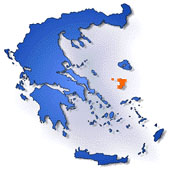
| The Greek island of Chios lies in the Eastern Mediterranean, a few miles off the Turkish coast. Together with the neighbouring islands of Oinousses and Psara and a sprinkling of smaller, uninhabited, rocky islets, it forms a distinct group. Within a relatively small area these islands offer a diverse range of habitats that include fertile cultivated land, forested hillsides, river valleys, rocky cliffs and mountain plateaux, marshes, dunes and beaches - all surrounded by the waters of the Aegean Sea. |
 |
 |
The geographical position of the islands places them on the migration route of many species of birds, making them an important staging post for some. Their isolation, and the non-intensive farming practices that have remained almost unchanged for hundreds of years, have allowed the survival of some rare species and the evolution of some unique and only recently described ones too. Specialists have recorded up to 75 different species of wild orchids alone, and (while experts debate the precise details of classification and taxonomy) that number seems likely to grow.
In common with most other parts of Greece, especially those that are near to the sea, Chios has sought to develop its tourist industry and has done so with some success. This has meant changes in agricultural practices as farmers leave the land to concentrate on earning a living in other ways. There is also a steady expansion of the local population. As a result the wildlife of the islands comes under pressure on several fronts. Just some of these are:
 |
|
Shooting in the hunting season |
|
Fewer cereal crops are grown |
|
Agricultural terraces are not maintained, leading to soil erosion |
|
Increased use of pesticides |
|
Expansion of the built environment |
|
Human disturbance |
|
Overgrazing |
We are happy to announce that we are making available on this site an interactive FLORA CHECKLIST for Chios (and other parts of the Eastern Aegean). The most recent update was posted in November 2012.

|